Free Destiny Number Calculator
Your Destiny Number, also known as the Expression Number, is calculated from the letters in your full birth name. In numerology, it is traditionally associated with your natural abilities, potential, personal expression, strengths and the qualities you may develop throughout life.
This calculator uses the Chaldean numerology system to calculate your Destiny Number. Enter your complete birth name below to discover your number and explore its traditional meaning, strengths, challenges, career tendencies, relationship style and personal growth lessons.
For the most consistent result, we recommend entering your full name as given at birth, including your middle name if it forms part of your birth name.
Destiny Number Calculator
Enter your Full Name:
Result
Destiny Number:
Your Personalized Destiny Number Interpretation
Enter your full birth name above to view your personalized interpretation.
Challenges:
How to Utilize These Traits:
How to Fix and Improve:
Destiny Traits:

Destiny Number Meanings: 1–9 and Master Numbers
The table below provides a general overview of the traditional qualities associated with each Destiny Number. These interpretations can help you understand common traits, natural strengths, possible challenges and areas for personal growth.
| Destiny Number | General Traits | Strengths | Challenges | How to Improve |
|---|---|---|---|---|
| 1 | Independent, ambitious, self-driven, confident and naturally inclined toward leadership. | Initiative, courage, originality, determination, strong willpower and the ability to take responsibility. | Can become impatient, overly dominant, stubborn, self-centred or uncomfortable accepting help from others. | Practice patience, listen to other viewpoints, cooperate with others and balance independence with teamwork. |
| 2 | Sensitive, cooperative, diplomatic, intuitive and naturally focused on harmony and relationships. | Empathy, patience, diplomacy, emotional awareness, teamwork and the ability to understand different perspectives. | May become overly sensitive, indecisive, dependent on approval or avoid necessary confrontation. | Develop stronger boundaries, trust your decisions, communicate openly and avoid taking every situation personally. |
| 3 | Creative, expressive, optimistic, social and naturally drawn toward communication and self-expression. | Communication, imagination, enthusiasm, humour, creativity and the ability to inspire others. | Can become scattered, inconsistent, overly emotional or struggle to complete what has been started. | Build discipline, focus on fewer goals at a time, create routines and channel creativity into consistent action. |
| 4 | Practical, disciplined, organised, dependable and naturally interested in structure and stability. | Persistence, planning, reliability, attention to detail, patience and the ability to build strong foundations. | May become rigid, overly cautious, resistant to change or too focused on rules and routine. | Remain open to new ideas, allow flexibility, take calculated risks and avoid becoming trapped in perfectionism. |
| 5 | Adventurous, adaptable, curious, energetic and strongly attracted to freedom, movement and new experiences. | Versatility, communication, quick thinking, adaptability, curiosity and the ability to handle change. | Can become restless, impulsive, inconsistent, easily distracted or uncomfortable with long-term commitments. | Create some structure, think before acting, develop consistency and balance freedom with responsibility. |
| 6 | Caring, responsible, protective, harmonious and naturally concerned with family, relationships and service. | Compassion, loyalty, responsibility, creativity, nurturing ability and a strong sense of duty. | May become controlling, overly responsible, perfectionistic or sacrifice personal needs for others. | Set healthy boundaries, allow others to take responsibility, practise self-care and avoid trying to solve every problem. |
| 7 | Analytical, introspective, thoughtful, spiritual and naturally interested in knowledge and deeper understanding. | Research, observation, intuition, analytical thinking, independence and the ability to understand complex subjects. | Can become isolated, overly sceptical, emotionally distant or spend too much time overthinking. | Stay socially connected, express feelings more openly, balance analysis with action and avoid excessive withdrawal. |
| 8 | Ambitious, organised, authoritative, practical and naturally focused on achievement, responsibility and material management. | Leadership, discipline, financial awareness, organisation, resilience and the ability to manage large responsibilities. | May become overly controlling, work-focused, materialistic, emotionally reserved or place excessive pressure on success. | Balance ambition with personal life, delegate responsibilities, remain ethical and develop emotional flexibility. |
| 9 | Compassionate, idealistic, generous, courageous and naturally interested in helping people or contributing to a larger purpose. | Empathy, generosity, broad vision, creativity, courage and the ability to inspire or support others. | Can become emotionally intense, overly idealistic, disappointed by others or struggle to let go of past situations. | Develop realistic expectations, practise emotional boundaries, accept endings and direct compassion toward practical action. |
| 11 | Highly intuitive, inspirational, sensitive and visionary. Master Number 11 is traditionally associated with heightened awareness and inspiration. | Intuition, creativity, inspiration, empathy, imagination and the ability to influence others through ideas or communication. | May experience nervous tension, self-doubt, emotional sensitivity, unrealistic expectations or difficulty grounding ideas. | Create practical routines, manage stress, turn inspiration into achievable goals and maintain emotional balance. |
| 22 | Practical visionary, disciplined builder and organiser. Master Number 22 is traditionally associated with turning large ideas into tangible results. | Planning, leadership, discipline, organisation, long-term vision and the ability to manage complex projects. | Can feel overwhelmed by responsibility, become excessively controlling, fear failure or place unrealistic pressure on achievement. | Break large goals into smaller steps, delegate responsibilities, maintain balance and focus on sustainable progress. |
| 33 | Compassionate, nurturing, expressive and service-oriented. Master Number 33 is traditionally associated with teaching, guidance and responsibility toward others. | Compassion, communication, creativity, emotional understanding, teaching ability and dedication to helping others. | May become overly self-sacrificing, emotionally burdened, perfectionistic or take responsibility for everyone's problems. | Set clear boundaries, practise self-care, help others without overextending yourself and accept that you cannot fix every situation. |
Note: Numerology is a traditional belief system. These descriptions are general interpretations and should be used for personal reflection rather than as fixed predictions.
How to Calculate Destiny Number:
Step 1: Write down your full name.
Step 2: Use the Chaldean Numerological Chart below to find the corresponding digits for each letter in your name.
Step 3: Assign the corresponding digit to each letter in your name according to the Chaldean chart.
Step 4: Add all the assigned digits together to get the total sum value.
Step 5: Reduce the total sum to a single digit by adding the digits together, unless the sum is a master number (11, 22, or 33).
Result: The resulting single digit or master number is your Chaldean Destiny Number.
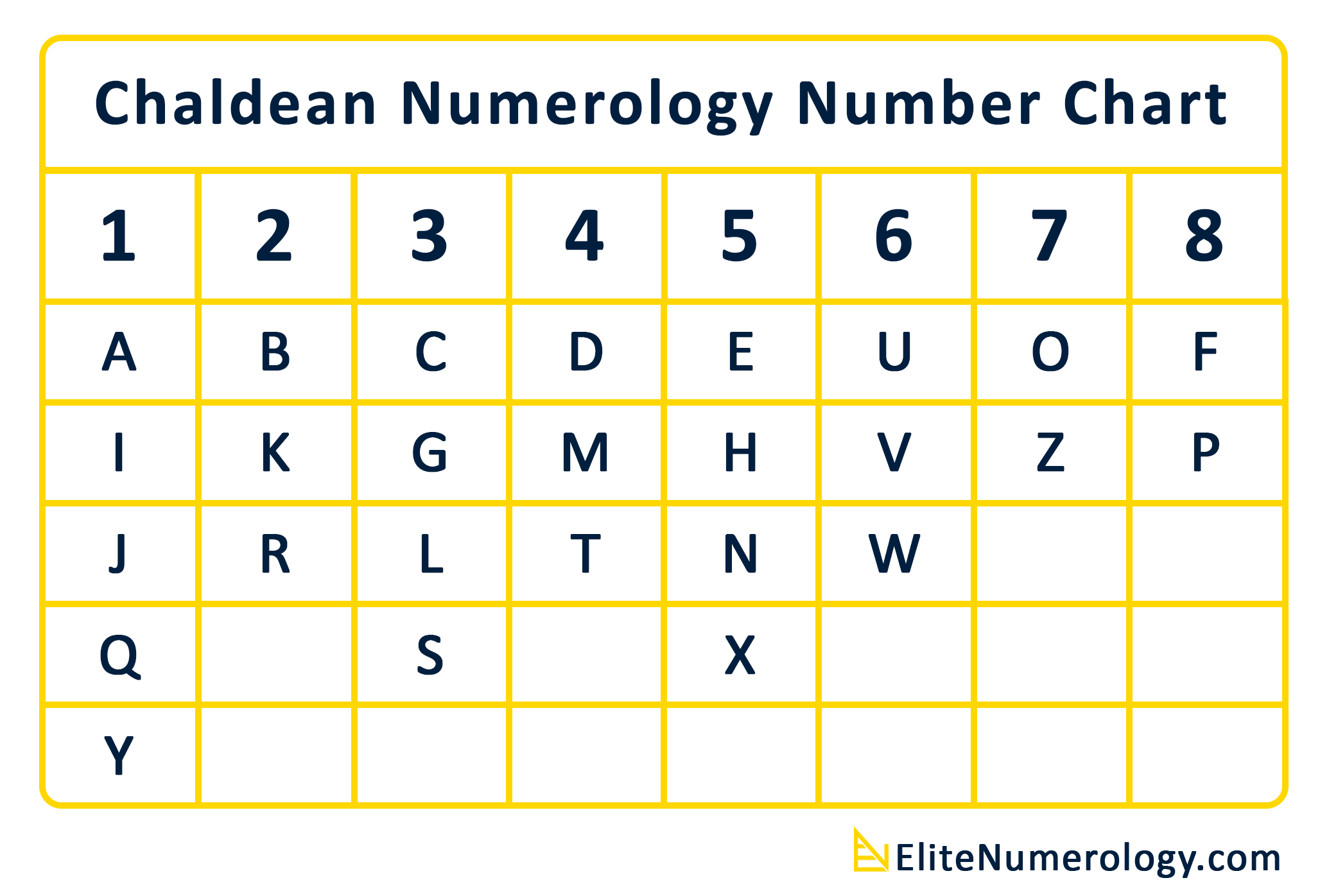
Step by Step Demo with Example:
1
Write Down the Full Name: Example: Ashish Batra
2
Use the Chaldean Numerological Chart to Find Corresponding Digits: A = 1, S = 3, H = 5, I = 1, B = 2, T = 4, R = 2
3
Assign Corresponding Digits to Each Letter: Ashish: A(1), S(3), H(5), I(1), S(3), H(5); Batra: B(2), A(1), T(4), R(2), A(1)
4
Add All Assigned Digits Together: Ashish: 1 + 3 + 5 + 1 + 3 + 5 = 18; Batra: 2 + 1 + 4 + 2 + 1 = 10; Total Sum: 18 + 10 = 28
5
Reduce the Total Sum to a Single Digit: 28 → 2 + 8 = 10 → 1 + 0 = 1
6
Determine the Chaldean Destiny Number: The Chaldean Destiny Number for Ashish Batra is 1.
Frequently Asked Questions
A Destiny Number, also known as the Expression Number, is calculated from the letters in your full birth name. In numerology, it is traditionally associated with your natural abilities, potential, personal expression, strengths, challenges and the qualities you may develop throughout life.
In the numerology system used on this page, Destiny Number and Expression Number refer to the same full-name calculation. Different numerology traditions may use slightly different terminology, but both commonly describe a number derived from the letters in your full birth name.
The Destiny Number is calculated by assigning numerical values to the letters in your full birth name using the Chaldean numerology chart. The values are added together and reduced to a final number, while Master Numbers such as 11, 22 and 33 may be retained depending on the calculation method.
We recommend using your complete birth name, including your middle name if it forms part of your original birth name. This keeps the calculation consistent with the traditional idea of the Destiny or Expression Number being based on the name given at birth.
Yes, if your middle name is part of your full birth name, it should generally be included. Using the complete birth name provides a more consistent full-name calculation.
Your birth Destiny Number remains the same because it is calculated from your original full birth name. If you later use or legally adopt another name, that new name can be analysed separately, but it does not replace the Destiny Number associated with your birth name.
A new legal or commonly used name can produce a different name-based numerology value. However, when Destiny Number is defined using the full birth name, the original birth Destiny Number remains unchanged. The new name may be studied separately depending on the numerology system being followed.
Each Destiny Number from 1 to 9 has a traditional numerology interpretation. Number 1 is associated with independence and leadership, 2 with cooperation and sensitivity, 3 with creativity and expression, 4 with structure and discipline, 5 with freedom and adaptability, 6 with responsibility and harmony, 7 with analysis and introspection, 8 with ambition and achievement, and 9 with compassion and service.
Master Numbers 11, 22 and 33 are traditionally given special importance in numerology. Number 11 is associated with intuition and inspiration, 22 with practical vision and large-scale achievement, and 33 with compassion, teaching and service. These numbers are also believed to carry greater responsibility and more demanding growth lessons.
The Destiny Number is calculated from your full birth name and is traditionally associated with your abilities, expression and potential. The Life Path Number is calculated from your full date of birth and is associated with your broader life journey, experiences and lessons.
The Destiny Number is calculated using all letters in your full birth name, while the Soul Urge Number is traditionally calculated using the vowels in your name. The Destiny Number relates to overall expression and potential, while the Soul Urge Number is associated with inner motivations, desires and emotional needs.
The Destiny Number is based on all letters in your full birth name, while the Personality Number is traditionally calculated from the consonants. The Destiny Number reflects overall expression and potential, whereas the Personality Number is associated with the qualities others may notice about you first.
Yes. Two people can share the same Destiny Number but still have very different personalities, experiences and life circumstances. Numerology usually considers several numbers together rather than using one number as a complete description of a person.
Traditional numerology may associate each Destiny Number with certain abilities, working styles and career tendencies. These interpretations can be used for personal reflection, but they should not replace your education, skills, interests, experience or professional career advice.
Numerologists may use the Destiny Number to explore communication style, personal expression and relationship tendencies. However, relationship compatibility usually involves more than one numerology number and should not be judged from the Destiny Number alone.
No. Every Destiny Number has its own strengths, challenges and growth areas. Numerology does not consider one number universally better than another. The value of a number depends on how its traditional qualities are understood and expressed.
Yes. You can calculate the Destiny Number for another person if you know their full birth name. The result should be treated as a general numerology interpretation rather than a complete description of that person.
Yes. The Destiny Number Calculator is free to use within the tool's applicable usage limits. One-to-one numerology consultations, if offered separately, may be paid services.
No. Numerology is a traditional belief system and has not been scientifically proven to predict personality, career, relationships or future events. The Destiny Number Calculator is intended for numerology interpretation and personal reflection.
A Destiny Number gives only one part of a numerology profile. Other numbers such as the Life Path Number, Soul Urge Number, Personality Number and other name or birth-date calculations may provide additional context. Numerology interpretations are general and should not be treated as fixed definitions of your personality or future.
Our Other Tools